


 PLATFORM UPDATE:


Functional tetrapodal zinc oxide: from synthesis and multiphysics to advanced applications

Abstract
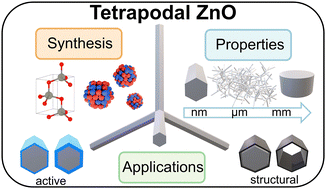
Tetrapodal zinc oxide (T-ZnO) represents a distinctive ZnO architecture, characterized by a central core and four tetrahedrally arranged monocrystalline arms. Beyond its role as a conventional particle, T-ZnO is increasingly recognized as a microscopic building block whose three-dimensional geometry governs tightly coupled multiphysics properties. This review critically examines the structural lifecycle of T-ZnO across multiple length scales. We evaluate scalable synthesis methodologies and competing thermodynamic models governing early-stage nucleation, followed by a systematic analysis of structure–property relationships. Structure–property correlations are addressed from the atomic scale of the crystal lattice, through the microscopic scale of individual tetrapodal particles, to the macroscopic aggregation of tetrapods into functional networks. Across these scales, the tetrapodal morphology dictates properties like mechanics, piezoelectricity, and optoelectronics via diverse and often competing effects. These properties are typically intertwined, producing physical coupling that generates both performance synergies and fundamental design trade-offs. The utility of this architecture is demonstrated in two principal domains: first, as an active functional particle network leveraging geometric stress concentration and percolation effects for applications such as advanced sensing; and second, as a sacrificial structural template for the fabrication of ultralight, highly porous aeromaterials that decouple the architectural advantages of the network from the intrinsic chemical limitations of ZnO. Ultimately, advancing T-ZnO from empirical optimization to rational technological deployment requires predictive multiphysics computational frameworks capable of guiding the design of its complex functionality.
 Please wait while we load your content...


