


 PLATFORM UPDATE:


Harnessing rare earth coordination chemistry for advanced photofunctional materials: from fundamental principles to emerging technologies

Abstract
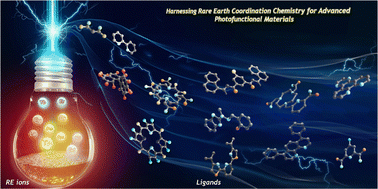
Rare earth (RE) ions, characterized by unique 4f electronic configurations and shielded f–f transitions, serve as exceptional optical centers exhibiting narrow-band emission, long-lived luminescence, and rich energy-level structures. The construction of high-performance RE coordination-based photofunctional materials critically relies on the synergistic integration of the “antenna effect”, provided by meticulously designed organic ligands, and the distinctive excited-state properties of RE ions. This molecular engineering approach not only maximizes the intrinsic photophysical advantages of RE elements, but also enables the precise tailoring of materials for diverse cutting-edge applications. This review provides a systematic and comprehensive analysis of RE coordination-based photofunctional materials, spanning from fundamental design principles and controllable synthesis strategies to emerging applications. We delve into the structure–activity relationships across various categories, including molecular complexes, supramolecular assemblies, coordination polymers, metal–organic frameworks (MOFs), and RE-covalent-bonded organic frameworks (RE-COFs). Furthermore, we highlight their transformative roles in optoelectronics, advanced anti-counterfeiting, biomedical imaging/therapy, radiation detection (scintillators) and photochemical catalysis. Finally, we outline current challenges and future perspectives, aiming to inspire interdisciplinary innovation and accelerate the commercialization of next-generation RE molecular photonic materials.
 Please wait while we load your content...


