


 PLATFORM UPDATE:


Nonadiabatic dynamics in the photodissociation of cis-HONO(Ã1A″,2 20)

Abstract
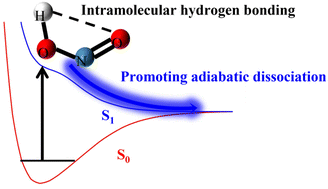
Nonadiabatic dynamics play an essential role in unraveling complex chemical processes. With intricacy existing in the dissociation product channels, HONO has emerged as a classic benchmark system for investigating nonadiabatic dynamics. To elucidate the dynamic interplay between nonadiabatic transition and intramolecular hydrogen bonding in the vicinity of the product asymptotic region, the photodissociation dynamics of cis-nitrous acid (cis-HONO,Ã1A″,220) have been investigated using the time-sliced velocity map ion imaging technique. It is found that the intramolecular hydrogen bonding in cis-HONO leads to a significant difference in the force field between cis- and trans-HONO, thereby leaving a characteristic fingerprint on their photochemical behaviors: the hydrogen bonding induces coupling between the N![[double bond, length as m-dash]](https://www.rsc.org/images/entities/char_e001.gif) O stretching vibration (ν2) and the in-plane ONO bending vibration (ν5) in the cis-isomer, resulting in an increase in the “rotational temperature” of the photoejected NO fragment; meanwhile, the hydrogen bond suppresses the excitation of the out-of-plane torsional mode, leading to a slight increase in the anisotropy of the dissociation products. Furthermore, the relatively significant intramolecular hydrogen bonding in cis-HONO renders the nonadiabatic transition probability negligible. This study provides key experimental evidence for understanding hydrogen bond-regulated nonadiabatic dynamics, and further high-level theoretical calculations are required to clarify the environmental effect of the ubiquitous intramolecular hydrogen bonding on nonadiabatic dynamics.
O stretching vibration (ν2) and the in-plane ONO bending vibration (ν5) in the cis-isomer, resulting in an increase in the “rotational temperature” of the photoejected NO fragment; meanwhile, the hydrogen bond suppresses the excitation of the out-of-plane torsional mode, leading to a slight increase in the anisotropy of the dissociation products. Furthermore, the relatively significant intramolecular hydrogen bonding in cis-HONO renders the nonadiabatic transition probability negligible. This study provides key experimental evidence for understanding hydrogen bond-regulated nonadiabatic dynamics, and further high-level theoretical calculations are required to clarify the environmental effect of the ubiquitous intramolecular hydrogen bonding on nonadiabatic dynamics.
- This article is part of the themed collection: Nonadiabatic events and conical intersections: in memory of David R. Yarkony
 Please wait while we load your content...


