


 PLATFORM UPDATE:


Synergistic effect of anomalous solvatochromism and fast relaxation on the enhancement of BEMT UV photoprotection performance

Abstract
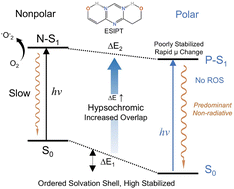
Bis-ethylhexyloxyphenol methoxyphenyl triazine (BEMT) is a highly efficient organic UV filter characterized by a broad ultraviolet absorption spectrum, exceptional photothermal stability and minimal skin penetration, which make it a core component in high-SPF sunscreen formulations. However, systematic research on the molecular photophysical behaviour of BEMT across various solvents—particularly its anomalous solvatochromism effect—remains scarce. This limited understanding results in the empirical selection of oil-based matrices during formulation development and hinders the targeted optimization of BEMT performance. Herein, we systematically investigate the spectral characteristics, excited-state relaxation pathways and photostability of BEMT in solvents with varying polarities and protonic properties. The ground-state-specific stability mechanism associated with the unique solvatochromism of BEMT is elucidated. In addition, this anomalous solvatochromism effect and the rapid excited-state relaxation process synergistically inhibit BEMT from photodegradation in polar media, reduce the generation of reactive oxygen species (ROS) and improve ultraviolet absorption efficiency, which provides both theoretical foundations and experimental support for the efficient formulation and performance optimization of BEMT in sunscreen preparations.
 Please wait while we load your content...


