


 PLATFORM UPDATE:


Flow-enhanced spatiotemporal pH oscillations
 a
and
István
Szalai
*b
a
and
István
Szalai
*b
Abstract
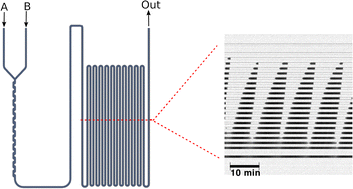
The interplay between nonlinear kinetics and transport can govern pattern formation in chemical and biological systems, yet the role of flow in feed-driven oscillatory systems remains incompletely understood. Sustained patterns require a continuous supply of fresh reactants, and periodic behavior typically emerges only within a specific range of feeding conditions. Here, we combine experiments and numerical modeling to investigate reaction–diffusion–advection dynamics in pH oscillators, a prototypical class of feed-driven systems. Using the bromate–sulfite and bromate–sulfite–ferrocyanide reactions in a laminar tubular reactor, we observe robust spatiotemporal oscillations that emerge at a finite distance from the inlet and are sustained by counterpropagating reaction fronts. The dynamics is driven by the competition between intrinsic kinetic delays and advective residence time. Simulations based on an extended Rábai model reveal that flow reshapes the nonequilibrium stability landscape, significantly enlarging the oscillatory domain compared to the reaction–diffusion case. Oscillations arise in an intermediate regime where the advective timescale becomes comparable to inhibitory delays, enabling a separation of activation and recovery processes. Simulations indicate that the faster diffusion of hydrogen ions stabilizes the oscillatory behavior. These results demonstrate that externally imposed flow can increase the robustness of oscillatory dynamics of feed-driven chemical networks.
 Please wait while we load your content...


