


 PLATFORM UPDATE:


Study of line tension and its impact on protein organization in model domain-forming membranes

Abstract
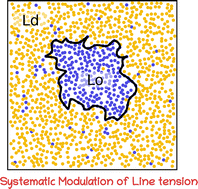
Membrane domains, commonly referred to as lipid rafts, play a crucial role in numerous cellular processes; however, the factors governing their stability and associated protein organization remain debated. Here, we employ coarse-grained molecular dynamics simulations to systematically investigate the molecular determinants of interfacial line tension and its role in membrane organization. We first demonstrate that capillary wave theory provides reliable estimates of line tension, provided that boundary fluctuations are adequately sampled. Our results reveal that domain stability is not primarily controlled by hydrophobic thickness mismatch; instead, it is governed by differences in molecular packing, quantified by the order parameter difference (ΔP2) between coexisting phases. Sterols, key components of biological membranes, modulate interfacial properties in a non-monotonic manner, with maximal domain stability observed at intermediate concentrations of around 10–15%. Furthermore, we find that transmembrane protein localization does not universally minimize line tension, but is instead dictated by hydrophobic thickness mismatch and specific lipid–protein interactions. These findings provide new mechanistic insights into the molecular origins of membrane domain stability and highlights the factors that regulate the spatial organization of transmembrane proteins at domain interfaces.
- This article is part of the themed collection: Physics for Sustainability: Health, Energy, and Environment - SPHERE
 Please wait while we load your content...


