


 PLATFORM UPDATE:


Telecom-band coherent perfect absorption and asymmetric interferometric light–light control in a borophene–dielectric nanostructure
 *ac
*ac
Abstract
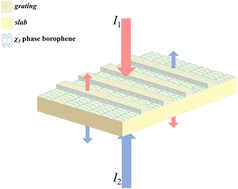
Efficient electromagnetic absorption is essential for optical modulation and integrated photonic devices and can be significantly enhanced by interference-assisted resonant nanostructures. Here, we propose a borophene–dielectric nanostructure operating at telecommunication wavelengths to realize tunable coherent perfect absorption (CPA). The structure supports guided-mode resonances (GMRs), which generate strong near-field enhancement near the borophene layer and promote efficient light–matter interaction. Under single-port excitation, resonance-enhanced absorption with directional asymmetry is observed, yielding peak absorption of 42.5% and 57.4% for opposite incidence directions. Under dual-port coherent excitation, CPA with a narrow bandwidth of 0.82 nm occurs at 1549.8 nm when the scattering matrix satisfies the zero-determinant condition. At the CPA wavelength, the absorption can be continuously tuned from below 10% to above 99.9% by adjusting the phase difference between the two incident beams. Electrical tuning of the borophene carrier concentration further enables a resonance shift of 12.4 nm while maintaining absorption above 95%, nearly fifteen times larger than the intrinsic CPA resonance linewidth. Structural asymmetry further leads to unequal external coupling strengths, enabling asymmetric interferometric light–light control under unequal-intensity excitation. These results demonstrate a compact platform for phase-controlled absorption and coherent optical switching in integrated photonic systems.
 Please wait while we load your content...


