


 PLATFORM UPDATE:


Is range separation always necessary for modeling TADF emitters? A benchmark study of B3LYP on dispersion-corrected geometries vs. tuned ωB97X-D
 †a
Anirban
Mondal
*a
†a
Anirban
Mondal
*a
Abstract
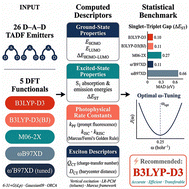
Thermally activated delayed fluorescence (TADF) emitters are commonly modeled using optimally tuned range-separated density functionals to capture their charge-transfer–dominated excited states. However, the necessity of such tuning remains an open question, particularly in view of its substantial computational cost. In this work, we present a systematic benchmark of density functional methods for predicting the ground- and excited-state properties of TADF molecules, based on a dataset of 26 experimentally reported emitters spanning diverse donor–acceptor architectures. We compare the performance of B3LYP augmented with Grimme's D3 dispersion correction (B3LYP-D3) against optimally tuned ω B97X-D, M06-2X, and related variants. The assessment covers frontier orbital energies, singlet and triplet excitation energies, singlet–triplet gaps, radiative and non-radiative rate constants, and exciton charge-transfer descriptors. Within the computational protocol employed here, we find that B3LYP-D3 provides consistent predictions for several ground-state properties and yields singlet–triplet energy gaps and photophysical rate constants that are comparable to those obtained with optimally tuned functionals. While tuning the range-separation parameter can improve the description of certain excited-state energies, these gains are not systematic across the dataset and must be considered alongside the associated computational overhead. Taken together, the results indicate that, within the present workflow, fortuitous error cancellation enables dispersion-corrected B3LYP geometries to achieve performance comparable to that of more computationally demanding, tuned range-separated functionals for this specific class of molecules. This observation suggests that B3LYP-D3 may offer a computationally efficient option for exploratory calculations and preliminary screening of TADF emitters, though care must be taken as these findings may not be directly transferable to other architectural or architectural-system classes not investigated here.
- This article is part of the themed collection: PCCP 2025 Emerging Investigators
 Please wait while we load your content...


