


 PLATFORM UPDATE:


Photoswitching behaviour of quinoline-substituted bicyclooctadienes and the role of protonation
 ab
Jacob Lynge
Elholm,
a
Rebecca J.
Salthouse,
a
Pedro
Ferreira,
a
Thomas
Robert,
b
Pascal
Gerbaux
*b
and
Kasper
Moth-Poulsen
*acde
ab
Jacob Lynge
Elholm,
a
Rebecca J.
Salthouse,
a
Pedro
Ferreira,
a
Thomas
Robert,
b
Pascal
Gerbaux
*b
and
Kasper
Moth-Poulsen
*acde
Abstract
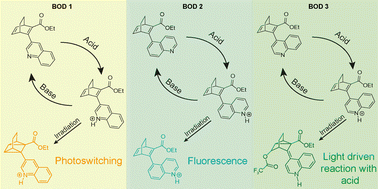
Molecular Solar-Thermal (MOST) systems employ photoswitches that convert solar energy into chemical energy in the form of a metastable isomer and release it as heat upon triggering. An example of such a photoswitch is bicyclooctadiene (BOD), which is converted into its higher energy photoisomer, tetracyclooctane (TCO), by a [2+2] cycloaddition upon UV light irradiation. Despite their potential as MOST candidates due to a high calculated energy storage density of ≈ 1.77 MJ kg−1, BODs are underinvestigated due to their retro Diels–Alder triggered degradation upon heating and very short half-lives of the TCOs in the order of seconds to minutes. Here we report the synthesis of three new acceptor–acceptor BOD isomers substituted with quinoline and the characterisation of their photophysical and photochemical properties. Two of the three BODs exist as a pair of rotational conformers with different absorption profiles, shown experimentally and supported by computational analysis. Calculated storage energies are found to be slightly higher than those of comparable naphthalene-substituted BODs, ranging from 144.0 to 163.6 kJ mol−1. We demonstrate that the substitution position of the quinoline has an influence on key MOST-relevant optical properties including thermal half-lives which range from 13 s to 6 min and the UV-vis absorption spectra. Protonation of the quinoline moiety induces a red shift of ≈ 40 nm in the absorption spectra of each BOD and leads to divergent behaviour upon irradiation, leading to photoswitching, fluorescence, or degradation, depending on the position of the nitrogen in the quinoline ring. These experimental and computational results elucidate how quinoline substitution and nitrogen position govern structure–property relationships in BOD photoswitches, providing design principles for further tuning and improving BODs and other photoswitches towards MOST application.
 Please wait while we load your content...


