


 PLATFORM UPDATE:


Electrostatically-driven assembly of cationic lipopeptides with hexacyanoferrate anions: a thermodynamic and in silico study
 a
and
Dariusz
Wyrzykowski
*a
a
and
Dariusz
Wyrzykowski
*a
Abstract
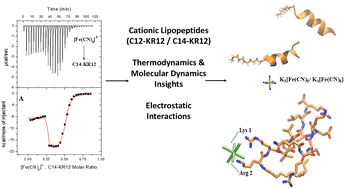
The electrostatic recognition between cationic antimicrobial peptides and anionic targets is crucial for their biological activity. However, the quantitative effects of peptide hydrophobicity on this interaction are not yet fully understood. Here, we elucidate the thermodynamic and structural basis of this process by investigating the binding interactions between hexacyanoferrate(II/III) anions, [Fe(CN)6]4−/3− and two variants of antimicrobial KR12 peptide, namely the laurylated (C12-KR12-NH2) and myristoylated (C14-KR12-NH2) KR12-lipopeptide. By employing an integrated approach that combined isothermal titration calorimetry (ITC), circular dichroism (CD) spectroscopy, and molecular dynamics (MD) simulations, it was found that hexacyanoferrate ions act as high-affinity electrostatic cross-linkers, stabilizing dimeric peptide assemblies. The secondary structure response was found to be governed by a competitive balance between intramolecular hydrophobic stabilization and intermolecular electrostatic interactions. For the lipopeptide with the shorter hydrophobic chain (C12-KR12-NH2), helical conformation was promoted by the screening of electrostatic repulsion upon anion binding. Conversely, a charge-dependent dual response was exhibited by the lipopeptide with a longer hydrophobic tail (C14-KR12-NH2). It has been shown that the length of the fatty acid chain plays a key role in determining the conformation of the lipopeptide after electrostatic binding. This provides a mechanistic basis for understanding the initial stage of recognition in antibacterial activity.
 Please wait while we load your content...


