


 PLATFORM UPDATE:


Moiety-specific mechanism of ATP's hydrotropic action on α-synuclein
 a
Toshifumi
Mori,
†bc
Benjamin
Kohn,
‡d
Erik
Walinda,
e
Daichi
Morimoto,
f
Ulrich
Scheler,
d
Masatomo
So,
a
Ayako
Furukawa,
a
Norio
Yoshida
g
and
Kenji
Sugase
*a
a
Toshifumi
Mori,
†bc
Benjamin
Kohn,
‡d
Erik
Walinda,
e
Daichi
Morimoto,
f
Ulrich
Scheler,
d
Masatomo
So,
a
Ayako
Furukawa,
a
Norio
Yoshida
g
and
Kenji
Sugase
*a
Abstract
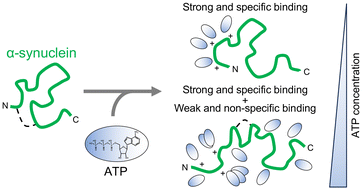
Adenosine triphosphate (ATP), the universal energy currency of life, also acts as a biological hydrotrope that maintains protein solubility. However, the molecular mechanism underlying its hydrotropic action, particularly how its distinct chemical moieties contribute to modulating protein conformation and preventing aggregation, remains unclear. Here, we combined NMR spectroscopy and molecular dynamics (MD) simulations to dissect the moiety-specific interactions between ATP and α-synuclein, an intrinsically disordered protein implicated in Parkinson's disease. NMR titration experiments monitoring ATP signals revealed that the adenine ring of ATP formed weak multisite interactions with α-synuclein, whereas the triphosphate group formed fewer but stronger contacts. MD simulations showed that the triphosphate-mediated contacts occurred primarily at N-terminal lysine residues and disrupted long-range intramolecular contacts, resulting in conformational expansion of α-synuclein. Energetic analysis indicated that this expansion incurred a conformational energy cost that was balanced by more favorable solvation. Based on these findings, we propose a “hierarchical binding hydrotrope mechanism”, in which the predominant contribution of each ATP moiety shifts with ATP concentration because the two moieties differ in microscopic affinity and the number of accessible interaction sites. Triphosphate-mediated binding, limited by the number of available binding sites, increases preferentially at lower ATP concentrations, whereas adenine-mediated binding increases progressively at higher concentrations. This mechanism provides a molecular basis for the concentration-dependent hydrotropic effects of ATP and clarifies how this metabolite modulates the conformational properties of aggregation-prone proteins under physiological conditions.
 Please wait while we load your content...


