


First-principles investigation of alloying element effects on hydrogen trapping and diffusion at the α-Fe/VC interface and within the VC bulk
 a
Shuai
Tang,
*a
a
Shuai
Tang,
*a
Abstract
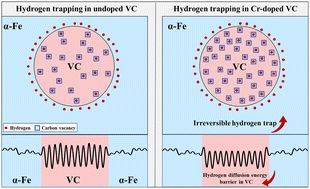
Utilizing internal carbon (C) vacancies in vanadium carbide (VC) precipitates is crucial for mitigating hydrogen embrittlement in high-strength steels. This study employs first-principles calculations to establish a comprehensive evaluation framework for alloying elements (Ti, Cr, Nb, Mo) influencing hydrogen trapping within VC, based on four atomic-level indicators: trap density (vacancy formation), trap stability (segregation energy), trap accessibility (diffusion barrier), and trap depth (escape barrier). Results indicate that Cr and Mo doping reduces C vacancy formation energy, increasing the density of irreversible traps. Uniquely, Cr significantly lowers the hydrogen diffusion barrier between vacancies, facilitating hydrogen migration into the carbide interior while maintaining trap irreversibility. Consequently, Cr doping appears to be a promising alloy design strategy for increasing the number of accessible irreversible hydrogen traps among the investigated elements, thereby potentially enhancing the hydrogen resistance of high-strength steels.
 Please wait while we load your content...


