


 PLATFORM UPDATE:


Combined double-hybrid DFT approach for the prediction of ΔEST and excited-state properties of MR-TADF emitters

Abstract
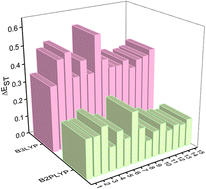
Multi-resonant thermally activated delayed fluorescence (MR-TADF) molecules are a class of organic emitters that are increasingly being explored for their applications in optoelectronics and display technologies. However, accurately predicting their lowest excited-state energies and singlet–triplet energy gap (ΔEST) remains a significant computational challenge due to the short-range charge transfer (SRCT) nature of their excited states. The standard time-dependent density functional theory (TD-DFT) method often fails to capture the SRCT characteristics, leading to an overestimation of ΔEST. In this study, fifteen experimentally reported MR-TADF emitters were benchmarked by performing geometry optimizations using the B3LYP functional, and further performed single-point excited-state calculations with the double-hybrid functionals B2PLYP and B2GP-PLYP. We obtained a mean absolute deviation (MAD) of ∼0.03 eV for the predicted ΔEST values of the MR-TADF emitters compared with experimental data using the B2PLYP functional. Our computational approach balances accuracy and efficiency to calculate the optical and excited-state properties of MR-TADF emitters. The validated methodology was further applied for calculating the optical properties of newly designed extended π-conjugated skeletons of BN-Cz core-based MR-TADF emitters.
 Please wait while we load your content...


