


 PLATFORM UPDATE:


Influence of blend composition on morphology and exciton-charge dynamics in MEH-PPV: PMMA thin films

Abstract
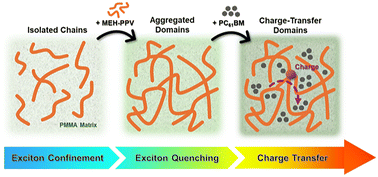
The interplay between morphology and exciton and polaron dynamics defines the photophysics of conjugated polymer blends. A systematic series of MEH-PPV:PMMA blend films, spanning from dilute dispersions to pristine MEH-PPV and ternary blends with PC61BM, was investigated. Absorption and photoluminescence (PL) spectra confirmed conserved electronic signatures across compositions, while fluorescence lifetime imaging microscopy revealed a continuous transition from uniform dispersion to nano-aggregation and micro phase separated networks. PL lifetime histograms showed a sharp decrease in lifetime at low fractions of MEH-PPV in PMMA, followed by a plateau in lifetimes at 10–25 wt%, identifying regimes where interchain interactions dominate exciton dynamics. Incorporation of PC61BM to the MEH-PPV:PMMA blends gives rise to significant reduction in exciton lifetime and introduced charge-transfer signatures consistent with electron transfer. Femtosecond transient absorption spectroscopy corroborated these pathways, resolving ultrafast singlet exciton decay, and formation of long-lived polarons combined with fullerene anion-radical absorption. The dynamics of charge-transfer and polaron decay are dominated by the local concentration of PC61BM in the MEH-PPV phase, as the acceptor is dispersed and partitions between the MEH-PPV and PMMA domains. The results establish a composition-resolved link between blend morphology and exciton and polaron dynamics, suggesting a pathway for controlling exciton and charge pathways in conjugated polymer systems.
- This article is part of the themed collection: Joint collection on photoluminescent organic materials
 Please wait while we load your content...


