


 PLATFORM UPDATE:


Resolving the trifecta of discrepancies regarding the phosphorus suboxide P4O
 ab
Alexander G.
Heide,
a
Mitchell E.
Lahm,
a
Henry F.
Schaefer, III
a
and
Yohannes
Abate
*b
ab
Alexander G.
Heide,
a
Mitchell E.
Lahm,
a
Henry F.
Schaefer, III
a
and
Yohannes
Abate
*b
Abstract
Unsatisfied with vibrational and mechanistic discrepancies between three previous investigations, we characterized the P4O potential energy surface with high-level coupled cluster methods for resolution, up to CCSD(T)/cc-pV(T+d)Z. Our computations substantiate the previous vibrational band assignments of Andrews and coworkers to cyclic and terminal P4O. The antisymmetric P–O stretch of bridge-bonded P4O was previously assigned to a band at 856 cm−1, and the symmetric stretch was assigned to a lower frequency band at 553 cm−1. In contrast, we find the symmetric P–O stretch of bridge-bonded P4O to lie higher than the antisymmetric, and formally assign the symmetric stretch to a previously unassigned 770 cm−1 band. Tentative assignments for the now-elusive antisymmetric P–O stretch of bridge-bonded P4O are discussed herein. To resolve mechanistic discrepancies, we demonstrate that the isomerization pathway between terminal and bridge-bonded P4O is a two-step process, requiring passage through a local-minimum intermediate on the potential energy surface. It was previously suggested that the antisymmetric P–O stretch band originally assigned to bridge-bonded P4O (856 cm−1) could instead belong to a D2d-symmetry P4O2 species, but our computed fundamental vibrational frequency (654 cm−1) does not support this suggestion. New insight has revealed our previous substantiation of the vibrational band assigned to cyclic P4O2 to be incorrect, and we now assign the positive combination antisymmetric P–O stretch to an unassigned 919 cm−1 band. Focal point analysis with basis sets up to cc-pV(Q+d)Z and correlation treatment to CCSDT(Q) is performed with the addition of zero-point vibrational energies for cyclic (−95.5 kcal mol−1), bridge-bonded (−92.5), and terminal P4O (−81.7) relative to tetrahedral P4 plus 3P oxygen as well as D2d-symmetry P4O2 (−62.0) relative to tetrahedral P4 plus  O2. We provide the energy of
 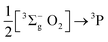 oxygen (+58.6 kcal mol−1) using our methods for comparison to previously reported P4O2 species with optimal error cancellation.

- This article is part of the themed collection: Nonadiabatic events and conical intersections: in memory of David R. Yarkony
 Please wait while we load your content...


