


 PLATFORM UPDATE:


Mechanistic investigation of nitridation-promoted reactivity and selectivity for propylene epoxidation in TS-1 catalysts: a theoretical study

Abstract
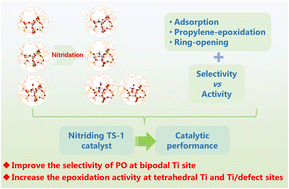
Lattice oxygen substitution by nitrogen (nitridation) within the TS-1 zeolite framework has emerged as a robust strategy to enhance catalytic performance in propylene epoxidation. However, the atomic-molecular level relationship between the microstructure of Ti active centers and catalytic performance remains elusive. Herein, we provide a systematic mechanistic analysis of the nitridation effects on TS-1 catalysts comprising tetrahedral Ti, Ti-defect, and bipodal Ti sites by examining the reaction pathways for propylene epoxidation and propylene oxide (PO) solvolysis and quantifying their corresponding potential energy landscapes. Results demonstrated that nitridation simultaneously improves both PO selectivity and epoxidation activity. The enhanced epoxidation activity is primarily attributed to the tetrahedral Ti and Ti-defect sites, which gain thermodynamic and kinetic advantages in forming stable intermediates and fostering stronger propylene–intermediate interactions. Meanwhile, the improved PO selectivity is derived from a significantly higher free energy barrier required for PO ring-opening activation at the nitrided bipodal Ti sites. This mechanistic understanding not only offers profound theoretical insights into nitrogen-doped zeolites but also guides the future design of high-efficiency TS-1 catalysts for propylene epoxidation.
 Please wait while we load your content...


