


 PLATFORM UPDATE:


Synergistic enhancement of hydrogen evolution on MoS2 by sulfur vacancy and transition metal doping: a DFT and machine learning study
 *a
*a
Abstract
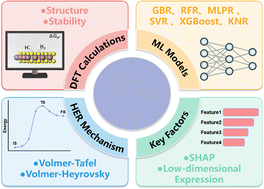
Two-dimensional (2D) MoS2 has emerged as a low-cost and efficient electrocatalyst for the hydrogen evolution reaction (HER). Although sulfur vacancy engineering and transition metal doping have been widely employed to enhance catalytic activity, their synergistic effects remain poorly understood. Herein, we systematically investigated the HER performance of transition metal-doped MoS2 with sulfur vacancies by integrating density functional theory (DFT) calculations and machine learning (ML) techniques. Our results reveal that metal dopants not only stabilize sulfur vacancy formation but also serve as active promoters for the HER at the vacancy site. Among 136 doped defective systems examined, 19 candidates exhibit near-optimal hydrogen adsorption free energies. The ML analysis based on the Support Vector Regression (SVR) model shows reliable predictive performance, while SHapley Additive exPlanations (SHAP) analysis reveals the Mo–S bond length adjacent to the sulfur vacancy and the valence electron count of the doped metal as key features controlling activity. Furthermore, SISSO analysis establishes a quantitatively interpretable relationship connecting structural and electronic features to HER activity. This study provides mechanistic insights into the synergistic effect of defect–dopant engineering in MoS2 and offers practical guidance for the rational design of efficient HER electrocatalysts.
 Please wait while we load your content...


