


 PLATFORM UPDATE:


Ab initio insights into plasmonic and strong-field contributions to H2 dissociation on silver nanoshells

Abstract
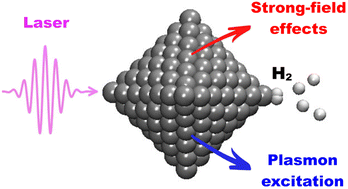
Modeling plasmonic catalysis by applying femtosecond laser pulses of high intensity (1013–1015 W cm−2), although justified by the time-dependent density functional theory (TDDFT) time-scale limitations, can lead to a dissociation mechanism that is completely unrelated to the plasmon excitation created under low-intensity continuous light in experiments (on the order of 1 W cm−2). In this study, we examine the dissociation of H2 on a large octahedral Ag nanoshell under varying field intensities, frequencies, and durations, and explore the possibility of identifying optimal modeling conditions accessible with current TDDFT simulations. We show that using this large nanoshell, which consists of an outer layer of the Ag231 cluster, it is still possible to disentangle the role of the plasmon from strong-field effects at applied field intensities as high as (2–8) × 1013 W cm−2. In particular, although strong-field effects are always present at these intensities, we find that the excited plasmon dominates the dissociation process at the lowest applied intensity of 2 × 10¹³ W cm−2. Furthermore, at the highest intensity, at which strong-field effects become dominant, the plasmon contributes to accelerating the dissociation of the molecule. Overall, our simulations pave the way for bridging the intensity gap between TDDFT modeling and experiments in plasmonic catalysis.
 Please wait while we load your content...


