


 PLATFORM UPDATE:


The impact of anion structure on the physicochemical and transport properties of hexamethylguanidinium-based sodium-ion electrolytes
 a
Julia
Debono,
a
Elene
Sasieta-Barrutia,
a
Luke A.
O’Dell,
a
Wladyslaw
Wieczorek,
b
Craig M.
Forsyth,
c
Maria
Forsyth
a
and
Jennifer M.
Pringle
*a
a
Julia
Debono,
a
Elene
Sasieta-Barrutia,
a
Luke A.
O’Dell,
a
Wladyslaw
Wieczorek,
b
Craig M.
Forsyth,
c
Maria
Forsyth
a
and
Jennifer M.
Pringle
*a
Abstract
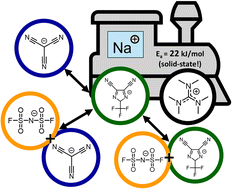
The molecular engineering of ionic liquid (IL) and organic ionic plastic crystal (OIPC) electrolytes could address critical challenges in developing safer, higher-performing sodium-ion energy storage systems. However, designing these materials remains challenging due to limited understanding of how anion structure influences physicochemical and transport properties. This work investigates the impact of anion type on electrolytes based on the hexamethylguanidinium ([HMG]+) cation. Two new salts were synthesized and characterized, [HMG]+ paired with tricyanomethanide ([TCM]−) and 4,5-dicyano-2-(trifluoromethyl)imidazolide ([TDI]−) anions. Single-crystal X-ray diffraction revealed that [HMG][TDI] crystallizes in a higher symmetry orthorhombic lattice compared to triclinic [HMG][TCM]. Differential scanning calorimetry (DSC) showed both salts are ordered crystalline solids with high entropies of fusion (ΔSf > 60 J mol−1 K−1). The anion's impact on thermal and transport behaviour was investigated in single- and mixed-anion mixtures: [HMG][TCM] + NaTCM; [HMG][TDI] + NaTDI; and with bis(fluorosulfonyl)imide ([FSI]−): [HMG][FSI] + NaTCM; [HMG][FSI] + NaTDI. In single-anion systems, increasing Na+ concentration formed new Na-rich phases. Remarkably, [HMG][TDI] + 50 mol% NaTDI exhibits an exceptionally low activation energy for ion transport of 22 kJ mol−1. In mixed-anion systems with [HMG][FSI], introducing NaTCM or NaTDI substantially impacted thermal behaviour and ionic conductivity, with [TCM]−-containing electrolytes demonstrating superior transport properties. This work provides fundamental insights into structure–property relationships in guanidinium-based ionic materials, exploring how anion structure dictates phase behaviour and ionic transport for next-generation sodium-ion electrolytes.
 Please wait while we load your content...


