


 PLATFORM UPDATE:


Rotational spectrum of laser-ablated mannitol: a conformational and photofragmentation study

Abstract
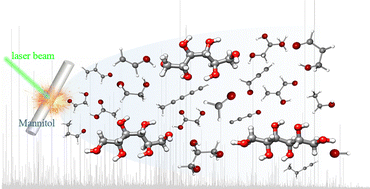
The conformational behavior of mannitol, an important sweetener, was studied using Fourier transform microwave spectroscopy combined with a laser-ablation source in a supersonic expansion. Three conformers were identified based on their rotational constants obtained from spectral analysis. The intramolecular hydrogen-bonding networks observed in the two most abundant conformers suggest a potential pre-organization mechanism that could favor a bioactive topology compatible with the T1R2/T1R3 sweet taste receptor. Such structural arrangements are consistent with the geometric criteria of Shallenberger's AH–B glucophore model, potentially reducing the entropic penalty of binding and providing a molecular-level hypothesis for the origin of its sweetness. A detailed spectral analysis, along with autonomous reaction-discovery calculations using AutoMekin, also revealed the simultaneous formation of additional species in the jet. This demonstrates that combining computational autonomous mechanism generators with laser ablation experiments offers a powerful new approach for exploring complex reaction dynamics and identifying chemical species inaccessible to traditional methods.
 Please wait while we load your content...


