


 PLATFORM UPDATE:


A systematic study of absorption, spin–orbit coupling and the rate of intersystem crossing in pristine and donor–acceptor substituted phosphahelicenes as a function of the position of the phosphole ring

Abstract
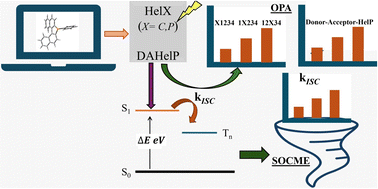
We present a systematic computational investigation of some important photophysical properties including absorption, spin–orbit coupling, and the rate of intersystem crossing (kISC) of pristine and donor–acceptor substituted phosphahelicenes. Three pristine phosphahelicenes with varying positions of the phosphole ring, along with their donor–acceptor substituted derivatives, are designed and studied in the vacuum phase and in four different solvents using state-of-the-art TD-DFT methods. For reference, the pristine systems were further compared with their carbohelicene analogues. The absorption spectra of phosphahelicenes and donor–acceptor substituted phosphahelicenes were found to be largely insensitive to solvent polarity and displayed a slight red shift relative to the corresponding HelC. Notably, relocation of the phosphole ring from the terminal to the central position of the helical backbone induced a pronounced blue shift of approximately 70 nm of the peak with the highest oscillator strength. In contrast, ISC rates were strongly dependent on both the position of the phosphole ring and the donor–acceptor substitution pattern. These trends are rationalized in terms of the orbital characteristics and the nature of the excited states involved.
 Please wait while we load your content...


