


 PLATFORM UPDATE:


Probing cysteine recognition by flavonoid probes: effects of triphenylamine substitution and DMSO/DCM solvents

Abstract
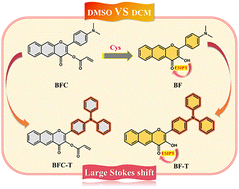
Recently, the first endoplasmic reticulum-targeting flavonoid-based fluorescent probe bearing an acrylate group (BFC) has been synthesized. It reacts with cysteine (Cys) to generate benzoflavonol (BF), which exhibits strong excited-state intramolecular proton transfer (ESIPT) characteristics, resulting in significant fluorescence enhancement and enabling efficient Cys detection. However, the fluorescence changes during detection and the ESIPT mechanism of BF remain experimentally unexplored. Herein, density functional theory (DFT) and time-dependent DFT (TD-DFT) methods were employed to clarify these processes and further investigate the influences of triphenylamine substitution (BFC-T and BF-T) and aprotic solvents of different polarities (dimethyl sulfoxide (DMSO) > dichloromethane (DCM)) on the photophysical properties and ESIPT process. The results show that photoexcitation strengthens the intramolecular hydrogen bonds of BF and BF-T, promoting ESIPT. The resulting tautomers exhibit strong fluorescence due to their localized emission, whereas the probes BFC and BFC-T exhibit weaker fluorescence owing to the twisted intramolecular charge-transfer (TICT) effect. Triphenylamine substitution in BFC-T and BF-T induces spectral red shifts, enlarged Stokes shifts, and more pronounced fluorescence changes. Still, it weakens the hydrogen bond of BF-T and raises its ESIPT energy barrier. Additionally, compared with DCM, all studied systems show a slight red shift in their spectra in DMSO, while BF and BF-T exhibit weakened hydrogen bonds and increased ESIPT barriers in this solvent. This study provides microscopic insights into the fluorescence sensing mechanism and is expected to offer theoretical guidance for the development of novel flavonoid-based probes.
 Please wait while we load your content...


