


 PLATFORM UPDATE:


Kinetics of the tetrahydrofurfuryl alcohol + ˙OH reaction from ab initio RRKM-master equation calculations

Abstract
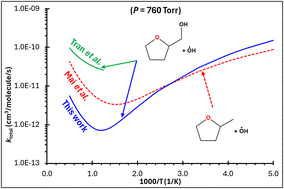
The kinetics of the reaction between tetrahydrofurfuryl alcohol (THFA), a potential biofuel, and ˙OH radicals were investigated using high-level ab initio calculations combined with Rice–Ramsperger–Kassel–Marcus/master equation (RRKM/ME) modeling over temperatures of 200–2000 K and pressures from 0.76 to 76 000 Torr, including corrections for hindered internal rotation and Eckart tunneling. A comprehensive potential energy surface for all hydrogen-abstraction pathways was constructed at the CCSD(T)/cc-pVTZ//M06-2X/aug-cc-pVTZ level. The ring oxygen atom induces a nonuniform electron density distribution, lowering C–H bond dissociation energies at the Cα positions and favoring hydrogen abstraction at these sites. The global rate coefficient exhibits slight pressure dependence at low temperatures due to pre-reactive complex stabilization, while pressure effects vanish above ∼800 K. The overall rate coefficient displays a characteristic U-shaped Arrhenius behavior and can be represented at 760 Torr by 7.23 × 10² × T−5.25 × exp(−269.7 K/T) + 7.40 × 10⁻²³ × T3.26 × exp(543.0 K/T) (cm3 per molecule per s). Below 500 K, the 2-(hydroxymethyl)tetrahydrofuran-2-yl radical (P4) + H2O and hydroxy(tetrahydrofuran-2-yl)methyl radical (P5) + H2O channels dominate, while above 700 K the 5-(hydroxymethyl)tetrahydrofuran-3-yl radical (P2) + H2O channel becomes predominant, reflecting the increasing importance of entropic effects at elevated temperatures. The calculated rate constants are consistent with those reported for the related 2-methyltetrahydrofuran + ˙OH system, supporting the reliability of the present kinetic model.
 Please wait while we load your content...


