


 PLATFORM UPDATE:


pH-dependent structural alterations in LHCII revealed by two-dimensional infrared spectroscopy

Abstract
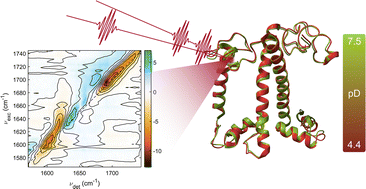
Light-harvesting complex II (LHCII) is the major light-harvesting antenna, which is responsible for harvesting sunlight energy and photoprotection of photosystem II. In this study, we assessed the structural changes in LHCII that are induced by lowering the pH. Absorption, circular dichroism and emission spectra of LHCII indicate that the trimeric LHCII samples were well intact and maintained in the light-harvesting state, exhibiting a single 3-ns exponential fluorescence decay. Fourier-transform and two-dimensional infrared spectroscopies reveal a frequency upshifting of amide I band of some α-helical elements upon increasing acidity, which could be interpreted as a combination of refolding of a 310 helix and a C-terminal coil to form new α-helices. Some sub-stoichiometry formations of β-motifs were also observed upon acidification with the β-sheet's size estimated at around 30–40 amino acids. This β-sheet can be formed with the N-terminal coil or co-folding between the N-terminus and the stromal loop. Our results demonstrate that lowering the pH induces significant structural changes in LHCII, but that they are not sufficient to switch LHCII into a quenched state. In the thylakoid membrane, such pH-dependent structural changes may enable specific protein–protein interactions between LHCII and other membrane proteins, in particular PsbS, that are required for non-photochemical quenching.
 Please wait while we load your content...


