


 PLATFORM UPDATE:


Surface reactions of iron precursors for focused electron beam induced deposition revealed by reflection absorption infrared spectroscopy

Abstract
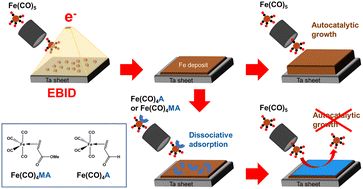
This study compares the thermal surface chemistry of Fe(CO)5, Fe(CO)4A (A = acrolein), and Fe(CO)4MA (MA = methyl acrylate) on Fe seed deposits produced by electron beam induced deposition (EBID) under UHV conditions. The deposits were prepared from Fe(CO)5 by continuous vapour dosing and simultaneous electron irradiation. Annealing to 450 K resulted in the removal of remaining CO from the surface. Reflection absorption infrared spectroscopy (RAIRS) showed continuous thermal reactions when Fe(CO)5 was dosed onto the deposit at room temperature. The characteristic ν(C![[triple bond, length as m-dash]](https://www.rsc.org/images/entities/b_char_e002.gif) O) bands were red shifted and broadened with increasing precursor dosage indicative of Fe aggregation. In comparison, vapour dosing of Fe(CO)4A and Fe(CO)4MA at room temperature produced a non-reactive monolayer coverage on the deposit. This fundamental difference in thermal surface chemistry is explained by a dissociative adsorption process of Fe(CO)4A and Fe(CO)4MA, which leads to chemisorbed species that suppress autocatalytic growth of Fe from the precursors. The thermal decomposition at monolayer coverage occurs even at temperatures as low as 115 K. Dosing of Fe(CO)5 on the chemisorbed adsorbates of Fe(CO)4A and Fe(CO)4MA also resulted in negligible thermal growth, as shown by Auger electron spectroscopy (AES) and RAIRS. Electron irradiation of the adsorbate did not reactivate the surface towards thermal decomposition of Fe(CO)5. The results show that the replacement of one CO ligand by an organic ligand A or MA can efficiently inhibit thermal deposit growth. The novel precursors Fe(CO)4A and Fe(CO)4MA can thus improve the control over the deposit shape in focused electron beam-induced deposition (FEBID) processes.
O) bands were red shifted and broadened with increasing precursor dosage indicative of Fe aggregation. In comparison, vapour dosing of Fe(CO)4A and Fe(CO)4MA at room temperature produced a non-reactive monolayer coverage on the deposit. This fundamental difference in thermal surface chemistry is explained by a dissociative adsorption process of Fe(CO)4A and Fe(CO)4MA, which leads to chemisorbed species that suppress autocatalytic growth of Fe from the precursors. The thermal decomposition at monolayer coverage occurs even at temperatures as low as 115 K. Dosing of Fe(CO)5 on the chemisorbed adsorbates of Fe(CO)4A and Fe(CO)4MA also resulted in negligible thermal growth, as shown by Auger electron spectroscopy (AES) and RAIRS. Electron irradiation of the adsorbate did not reactivate the surface towards thermal decomposition of Fe(CO)5. The results show that the replacement of one CO ligand by an organic ligand A or MA can efficiently inhibit thermal deposit growth. The novel precursors Fe(CO)4A and Fe(CO)4MA can thus improve the control over the deposit shape in focused electron beam-induced deposition (FEBID) processes.
 Please wait while we load your content...


