


 PLATFORM UPDATE:


Interplay of structure and dynamics in solid polymer electrolytes: a molecular dynamics study of LiPF6/polypropylene carbonate
 *ac
Thomas
Meyer,
b
Claire
Villevieille,
b
Fannie
Alloin,
b
Stefano
Mossa
a
and
Benoit
Coasne
*cd
*ac
Thomas
Meyer,
b
Claire
Villevieille,
b
Fannie
Alloin,
b
Stefano
Mossa
a
and
Benoit
Coasne
*cd
Abstract
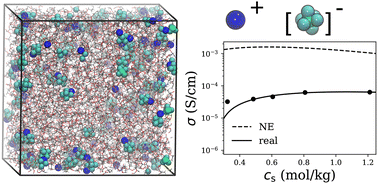
Solid-state batteries (SSBs) are emerging as the next generation of electrochemical energy storage devices. In this context, obtaining high energy density batteries relies on the use of solid polymer electrolytes (SPEs) that are electrochemically stable with respect to lithium metal and high potential positive electrodes (both conditions being difficult to achieve without chemical degradation). Here, molecular dynamics simulations are used to investigate the interplay of the structure and dynamics of a carbonate-based SPE composed of polypropylene carbonate and lithium hexafluorophosphate (LiPF6) at salt concentrations ranging from 0.32 to 1.21 mol kg−1. On the one hand, the structural properties of such a SPE are studied under ambient pressure and at the experimentally relevant temperature T = 353 K. On the other hand, considering that the very slow processes involved in these systems are out-of-reach of molecular dynamics, the dynamic properties are simulated at high temperature up to 900 K and then extrapolated to T = 353 K using Arrhenius' law. Our results reveal strong ionic correlations with a limited fraction of free ions and a prevalence of negatively charged clusters (particularly at the highest salt concentrations). The self-diffusion coefficient of Li+ exceeds that of PF6− at high temperature due to the weaker Li+–carbonate and ion–ion interactions. However, the Li+ mobility at T = 353 K is lower than that of the anion (Ds+ ∼ 3.0 × 10⁻¹⁵ m2 s−1), in agreement with the typical experimental SPE behavior reported in the literature. As expected, our MD simulations show that the ionic conductivity σ increases with temperature. Moreover, σ at T = 353 K exhibits a maximum at a salt concentration between 1.0 and 1.1 mol kg−1 (σ ∼ 6.5× 10⁻⁵ S cm−1). Overall, our estimated physico-chemical parameters indicate that strong ion correlations can be optimized to design a better SPE. In this context, the Arrhenius extrapolation approach employed here provides insights into ion transport mechanisms in SPEs.
- This article is part of the themed collection: Physics for Sustainability: Health, Energy, and Environment - SPHERE
 Please wait while we load your content...


