


 PLATFORM UPDATE:


Alternative graph-4-yne stacking fashion: toward selective CO2 capture
 *a
Giacomo
Giorgi,
bcde
Yusuf Bramastya
Apriliyanto,
f
Andrea
Lombardi
*ab
and
Noelia
Faginas-Lago
ab
*a
Giacomo
Giorgi,
bcde
Yusuf Bramastya
Apriliyanto,
f
Andrea
Lombardi
*ab
and
Noelia
Faginas-Lago
ab
Abstract
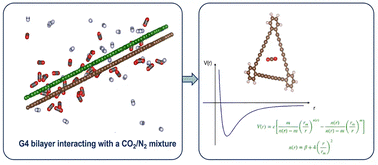
In the present study, we investigate the stacking configurations of bilayer and trilayer graphtetrayne, a promising carbon-rich two-dimensional material derived from graphene, by integrating literature-reported structures with a synergistic computational approach that combines classical molecular dynamics and ab initio calculations. The classical molecular dynamics simulations are performed adopting the improved Lennard-Jones (ILJ) formulation of the potential, a crucial choice to easily explore the configurational space identifying low-energy arrangements followed by a more precise investigation performed through ab initio calculations for accurate energetic evaluation and refinement of structures. Through this combined methodology, we identified a stacking mode present in both isolated and stacked bilayer structures, which, although previously reported in aqueous environments, is here characterized in the gas phase and found to be significantly more stable than the configurations proposed in the literature. Furthermore, molecular dynamics simulations of an equimolar CO2/N2 mixture revealed a marked preference for carbon dioxide uptake by the bilayer structures. These results indicate that the bilayer structure preferentially accommodates CO2 due to favorable quadrupole–π interactions, linear geometry, and accessible pore morphology, providing initial quantitative evidence of its potential for selective CO2 capture. The present findings not only contribute to the fundamental understanding of graphtetrayne bilayers, but also highlight the potential of carbon-based nanomaterials for the design of efficient membranes for environmental and energy-related applications.
- This article is part of the themed collection: Structure and dynamics of chemical systems: Honouring N. Sathyamurthy’s 75th birthday
 Please wait while we load your content...


