


 PLATFORM UPDATE:


Electron beam radiolysis of methane to produce hydrogen: modelling the first generation of products

Abstract
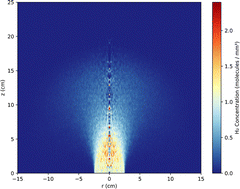
The initial stages of producing hydrogen from methane using electron beam radiolysis was explored numerically. A Monte Carlo model was developed to track electrons with initial energies up to 100 keV through a series of inelastic scattering events down to 1 eV. This model included 28 different cross sections to provide detailed probabilistic event data and was subsequently combined with the output of EGSnrc (an open-source code for generic electron transport) to provide the spatial distribution of key species (i.e., seven cations, one anion, four radicals, and hydrogen gas) that were directly formed by radiolysis. These species are referred to as first-generation products. Key conclusions include: most of the incoming energy formed first-generation products (e.g., for 100 keV, 83.1% of that incoming energy formed first-generation products, 16.5% went towards molecular excitation, with the balance being photon emissions); lower energy electrons were more effective in the direct production of H2 having a G-value of unity while post-radiolysis chemistry is responsible for most of the H2 produced; higher energy incoming electrons displaced the formation of reacting species away from where they entered the methane to avoid surface fouling (e.g., comparing 20 keV to 100 keV incoming energies push this distance from 0.5 cm to 4.9 cm); and, to quantitatively predict the local concentration of first-generation species for a specified energy input as a starting point for chemical kinetic modeling that will form the stable products, including hydrogen.
 Please wait while we load your content...


