


 PLATFORM UPDATE:

Electron–electrophile coupled dinitrogen reduction in a cerium–meta-tetraphenolate system: a computational study

Abstract
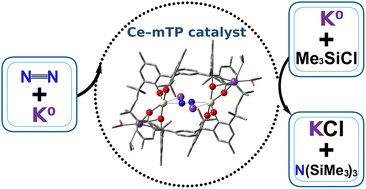
The use of lanthanide complexes for catalytic dinitrogen reduction is a new development in homogeneous catalysis. Density functional theory calculations on our recently reported cerium phenolate catalyst [K2Ce2(sol)4(mTP)2] (mTP = {(OC6H2-2-tBu-4-Me)2CH}2-1,3-C6H4; sol = OMe2 here; THF in the experiment) have been undertaken to elucidate the reduction, activation and silylation steps at the bound dinitrogen molecule, in the presence of the reductant, potassium metal (K0) and the electrophile Me3SiCl (TMSCl). Out of the total of six electron reductions required to cleave the N2, the first two-electron reduction step was found to be highly disfavoured unless potassium cations (K+) are included, upon which the step is rendered strongly exergonic; N–Si bond formation at the two-electron stage is predicted to be unfavourable. The three-electron-reduced N2-adduct is found to be at the reductive activation limit in the absence of added electrophiles, which can form N-element bonds and lower the overall charge. Added electron density beyond three-electron reduction no longer localises on N2, preventing formal N24− formation. A pathway in which both K0 and Me3SiCl work in concert was modelled, and six sequential reduction–silylation steps were calculated, showing how the N–N bond is cleaved after the third reduction, eventually releasing two equivalents of N(SiMe3)3, and regenerating the starting complex with the highest barrier of any step being 22 kcal mol−1. We establish alkali metal coordination and coupled electron–electrophile transfer as key factors in the design of rare-earth-mediated dinitrogen functionalisation.
 Please wait while we load your content...


