


 PLATFORM UPDATE:


Giant transmitted Goos–Hänchen amplification via high-Q resonant tunneling for angle-interrogation refractometry
 *ab
*ab
Abstract
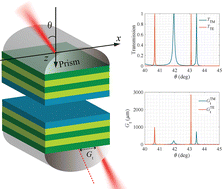
We report a prism-coupled multilayer platform that combines near-unity optical throughput with giant transmitted Goos–Hänchen (GH) displacements by engineering a high-Q resonant-tunnelling state in an inorganic dielectric stack. Two Bragg mirrors separated by an evanescent coupling gap and symmetric phase-matching layers form an impedance-matched tunnelling channel that yields an ultranarrow angular transmission window accompanied by a steep transmission-phase dispersion. Because the transmitted GH shift is governed by the angular derivative of the transmission phase, the abrupt phase excursion at the tunnelling resonance produces orders-of-magnitude enhancement of the transmitted lateral displacement while maintaining high signal power. For a representative design at a wavelength of λ = 1.55 µm with a prism index np = 1.44 and Bragg layers (nH, nL) = (3.7, 1.46) of thicknesses (dH, dL) = (0.11, 0.39) µm repeated N = 4 periods on each side, together with symmetric cavity layers of thickness dC = 0.12 µm (index nC = 1.46) and a gap thickness dG = 5.0 µm, the tunneling resonance yields ultranarrow angular transmission windows approaching unity and produces peak transmitted shifts on the order of 104 µm. The platform is further adapted for refractometric sensing by filling the coupling gap with an analyte, where variations in the gap refractive index perturb both phase matching and the evanescent decay constant, leading to a pronounced angular shift of the GH peak with a sensitivity of 53.8 deg per RIU, enabling high-contrast angle-interrogation readout. These results establish resonant tunnelling in dielectric multilayers as a high-throughput route to beam-shift amplification and compact angle-interrogation refractometry.
 Please wait while we load your content...


