


 PLATFORM UPDATE:


Two-dimensional materials as emerging electrocatalysts for the HER, ORR, and OER: design strategies, challenges, and prospects in sustainable energy conversion

Abstract
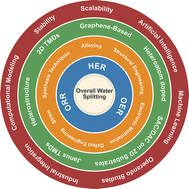
Two-dimensional (2D) materials have emerged as a versatile platform for high-performance electrocatalysts in sustainable energy conversion and storage technologies, including fuel cells, water splitting, and metal–air batteries (MABs). The central part of the electrochemical reactions, such as the H2 evolution reaction (HER), O2 reduction reaction (ORR), and O2 evolution reaction (OER), determines the efficiency, performance, and stability of these 2D materials. While noble metals like Pt, Ir, and Ru exhibit superior activity, their high cost and limited durability hinder large-scale applications. 2D materials, including transition metal dichalcogenides, MXenes, doped graphene, and single-atom 2D catalysts, offer tunable electronic structures, high surface area, abundant active sites, and defect-rich architectures, enabling efficient and durable catalysis. Combined with advanced computational approaches, such as density functional theory (DFT) calculations and machine learning (ML), these materials provide a pathway for rational design and high-throughput screening of next-generation electrocatalysts. This review critically summarizes recent progress in 2D material-based electrocatalysts for the HER, ORR, and OER, highlighting design strategies, synthesis techniques, stability challenges, and emerging trends toward scalable and practical energy conversion technologies.
- This article is part of the themed collection: 2026 PCCP Reviews
 Please wait while we load your content...


