


 PLATFORM UPDATE:

Charge regulation and surface complexation modeling in nanoscale 2D geometries: benchmarking and test cases of a novel code (CRESCENDO)

Abstract
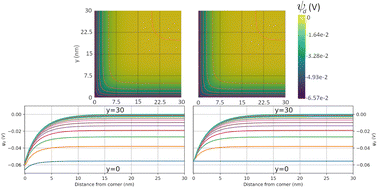
Mineral surfaces in contact with aqueous solutions develop an electric double layer (EDL) through surface (de-)protonation reactions and adsorption of ions, diffusion, and electrostatic forces, resulting in a Stern- and a diffuse layer of ions. Most current models used for surface speciation calculations do not consider changes in surface chemistry caused by charge regulation effects, i.e. effects of interacting EDLs of surfaces in close proximity. Charge regulation modeling requires equilibrium calculation of every involved surface simultaneously, while also solving the Poisson–Boltzmann equation (PBE) to quantify electrostatic interaction. Since analytical solutions of the PBE for complex geometries do not exist it becomes necessary to solve such problems numerically. A Python code is presented that combines a general chemical speciation code, Three Plane Surface Complexation Model, and a Finite Element solution of the PBE on two-dimensional domains. The Finite Element PBE solver is benchmarked against analytical solutions and the speciation code is benchmarked against a PHREEQC model as well as an existing 1D charge regulation code. A test case involving charge regulation in a corner of two perpendicular surfaces is modeled. Charge regulation modeling on a nanoscale enables simulations of the electrostatic environment and surface chemistry in nano-confined systems and interactions of nanoparticles. This may also improve simulations of environmental and biological systems, cementitious materials and modeling of the electrostatic environment and sorption on nanoporous clay materials. Such information can be vital for the in depth understanding of natural and engineered barrier systems of nuclear waste repositories or other environmental scenarios.
 Please wait while we load your content...


