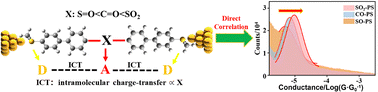
Mechanism of molecular conductance enhanced via the D-A effect

Abstract

Donor-acceptor (D-A) molecular architecture is widely employed in the design of organic semiconductors; however, its charge transport characteristics at the single-molecule level remain rarely explored. To elucidate the intrinsic mechanism, this study integrates single-molecule conductance measurements, photophysical spectroscopy, and quantum chemical calculations to research D-A molecule systems. It shows that the D-A effect on conductance enhancement is not governed by a reduced molecular bandgap or a lowered charge injection barrier, but related to the reduction in exciton binding energy for the charge when transported across two electrodes through the molecule

Supplementary files

Transparent peer review

To support increased transparency, we offer authors the option to publish the peer review history alongside their article.

View this article’s peer review history

Article information

Article type
Communication
Submitted
14 Jan 2026
Accepted
09 Feb 2026
First published
12 Feb 2026

Phys. Chem. Chem. Phys., 2026, Accepted Manuscript

Mechanism of molecular conductance enhanced via the D-A effect

W. Feng, T. Hou, X. Li, W. Du, Y. Li and Z. Wang, Phys. Chem. Chem. Phys., 2026, Accepted Manuscript , DOI: 10.1039/D6CP00130K

To request permission to reproduce material from this article, please go to the Copyright Clearance Center request page.

If you are an author contributing to an RSC publication, you do not need to request permission provided correct acknowledgement is given.

If you are the author of this article, you do not need to request permission to reproduce figures and diagrams provided correct acknowledgement is given. If you want to reproduce the whole article in a third-party publication (excluding your thesis/dissertation for which permission is not required) please go to the Copyright Clearance Center request page.

Read more about how to correctly acknowledge RSC content.

Social activity

Spotlight

Advertisements