


 PLATFORM UPDATE:

The effect of heavy atoms on the thermally activated delayed fluorescence properties of naphthalimide–phenoselenazine electron donor–acceptor dyads: electron transfer and intersystem crossing
 †ab
Antonio
Toffoletti,
d
Jianzhang
Zhao,
*a
Yanqin
Li,
*b
Yan
Wan
*c
and
Antonio
Barbon
*d
†ab
Antonio
Toffoletti,
d
Jianzhang
Zhao,
*a
Yanqin
Li,
*b
Yan
Wan
*c
and
Antonio
Barbon
*d
Abstract
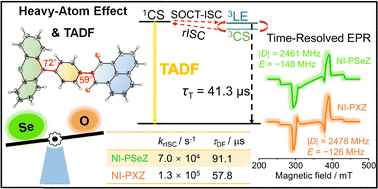
We prepared two electron donor–acceptor dyads based on naphthalimide (NI) as the electron acceptor and 10H-phenoxazine (PXZ) or 10H-phenoselenazine (PSeZ) as the electron donor. Both NI–PXZ and NI–PSeZ exhibit thermally activated delayed fluorescence (TADF). The purpose of this study is to unravel the effects of heavy atoms on the TADF properties, which are believed to enhance the reverse intersystem crossing (rISC); thus, more dark 3CS and 3LE states are transformed into the emissive 1CS state, so that the TADF properties are enhanced by the presence of heavy atoms such as Se in the molecular structure. Steady state UV-vis absorption and fluorescence studies show negligible interaction between the donor and acceptor at the ground state (S0), yet charge transfer (CT) emission was observed, indicating interaction between the radical anion and the radical cation of the CS state. We didn’t observe shortened delayed fluorescence lifetime for NI–PSeZ (τPF = 14.9 ns, τDF = 91.1 µs) as compared to the analogues of NI–PXZ (τPF = 24.3 ns, τDF = 57.8 µs) and the previously reported NI–PTZ (τPF = 11.9 ns, τDF = 82.1 µs); therefore the heavy atom effect for the rISC is not significant. Moreover, femtosecond transient absorption spectroscopy only captures the 1CS state as the final species and the charge separation and recombination become faster in polar solvetns. Nanosecond transient absorption spectra show the presence of a low-lying 3NI state in non-polar solvents (τT = 41.3 µs), an admixture of the 3NI state and the 3CS state (τT = 23.5 µs) in solvents with intermediate polarity, and only the 3CS state (τT = 0.8 µs) in polar solvents. These observations support the spin-orbit charge transfer ISC (SOCT-ISC) mechanism. The results further show that the rISC is not enhanced by the heavy atom effect, for NI–PSeZ, the krISC = 7.0 × 10⁴ s−1, in comparison, krISC = 1.3 × 10⁵ s−1 for NI–PXZ, and krISC = 1.4 × 10⁷ s−1 for NI–PTZ. Time-resolved electron paramagnetic resonance (TREPR) spectral studies show that the localized triplet state (3NI) is the last triplet state for the dyads in a frozen solution at 80 K, and based on the selective population of the three sublevels of the T1 state, SOCT-ISC may contribute to the formation of the triplet states.
 Please wait while we load your content...


