


 PLATFORM UPDATE:


Tuning halogen bond donor ability: benchmarking substituent effects in fluoroiodobenzenes

Abstract
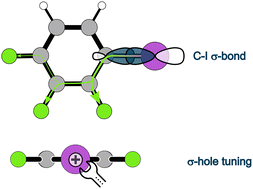
In high-resolution spectroscopy, electric nuclear quadrupole coupling can provide insights into a molecule's electronic structure. In a systematic study, we investigated the mesomeric and inductive effects exhibited by the fluorine substituents in various fluoroiodobenzenes. We characterised all 19 possible substitution patterns of fluorinated iodobenzenes using cavity resonator Fourier transform microwave jet spectroscopy, which included measuring the aforementioned coupling constants. By systematically implementing the extended Townes–Dailey model, we quantified the polarisation of the iodine atom to investigate its ability to act as a halogen bond donor, using the iodine atom as a probe. In this way it can be determined how halogen bond donor abilities are influenced by mesomeric and inductive effects. The results were compared to those obtained from an intrinsic basis bonding analysis (IBBA). Additionally, we used a large quantity of experimental data to rigorously benchmark numerous levels of theory in terms of their structure predictions and nuclear quadrupole coupling constants. To gauge the influence of zero-point effects on the rotational constants, vibrational perturbation theory of second order (VPT2) was also applied.
- This article is part of the themed collection: Bunsen-Tagung 2025 - Physical Chemistry of the Climate and the Atmosphere
 Please wait while we load your content...


