


 PLATFORM UPDATE:

Water-mediated conformer-selective desorption of n-propyl cyanide from mixed ices

Abstract
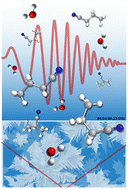
Complex molecules formed in astrophysical ices may exist as different conformers, yet conformer-specific desorption under interstellar medium-relevant conditions remains poorly constrained. This in turn may give rise to uncertainties that impact inferred column densities for these species. Nitrogen-bearing species are particularly advantageous targets to study these issues owing to their large dipole moments, and n-propyl cyanide (n-PrCN), the smallest cyanide exhibiting rotational isomerism, serves as a benchmark system for investigating conformer-dependent ice-gas phase evolution. Here, we report the first measurement of the conformer interconversion barrier of n-propyl cyanide in the condensed phase (2044.9 ± 289 K) obtained using in situ reflection–absorption infrared spectroscopy (RAIRS). Mixed n-PrCN:H2O ices were also examined, yielding a significantly higher interconversion barrier for an 80 : 20 composition. In addition to in situ characterization of the ice, gas-phase detection of products is achieved with chirped-pulse mm-wave detection of molecules during temperature-programmed desorption, where neat n-PrCN ice produces a gauche fraction of 0.80 ± 0.03 in the gas phase. Conformer populations are tracked throughout ice warm-up and phase transitions. Finally, we find that crystallization of n-PrCN in mixed ices is suppressed until the onset of water ice crystallization, demonstrating that ice composition and morphology regulate desorption with conformer-specificity.
- This article is part of the themed collections: PCCP 2025 Emerging Investigators and 2026 PCCP HOT Articles
 Please wait while we load your content...


