


 PLATFORM UPDATE:


DFT insights into metal-functionalized black phosphorene as a potential volatile organic compound sensor for early cancer detection
 *a
and
*a
and
Abstract
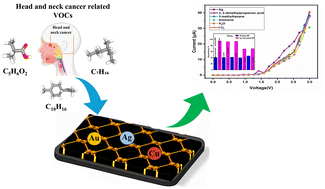
Volatile organic compounds (VOCs) in human breath are increasingly being recognized as powerful non-invasive indicators of cancer, yet achieving their selective and real-time detection at trace levels remains a major challenge. Herein, noble metal-decorated black phosphorene (BP) is introduced as a new class of nanosensors for head and neck cancer (HNC) biomarkers. The interactions of limonene, 2,2-dimethylpropanoic acid, and 3-methylhexane with the sensing substrates were investigated using first-principles calculations based on the density functional theory (DFT) combined with the non-equilibrium Green's function (NEGF) approach. Pristine BP was found to exhibit only weak physisorption (−27.98 to −40.52 kJ mol−1), whereas metal (Au, Ag, and Cu) functionalization dramatically enhanced its sensitivity. Among the systems examined, Ag@BP exhibited the strongest adsorption energy of −129.29 kJ mol−1 (limonene), −56.93 kJ mol−1 (2,2-dimethylpropanoic acid), and −36.66 kJ mol−1 (3-methylhexane). These interactions induced a noticeable charge rearrangement, the formation of electronic states in proximity to the Fermi energy level, and a transition from the semiconducting to metallic behaviour. Current–voltage analysis revealed remarkable sensitivity enhancements as Ag@BP achieved 90–95% conductance changes, whereas pristine BP showed only 1–65%. Recovery time calculations further highlighted the strong chemisorption of limonene (4.4 × 10¹⁰ s at 298 K, shortened to 35.8 s at 498 K) and ultrafast desorption of 2,2-dimethylpropanoic acid (6.17 × 10⁻⁴ s) and 3-methylhexane (2.65 × 10⁻⁶ s), ensuring stability with reversible operation. These findings prove that Ag@BP is a highly sensitive and recyclable 2D nanoplatform for real-time breath-based cancer diagnostics.
 Please wait while we load your content...


