



Pore water effects on the structure, bonding, dynamics and mechanical properties of calcium silicate hydrate: a molecular dynamics investigation
 *a
*a
Abstract
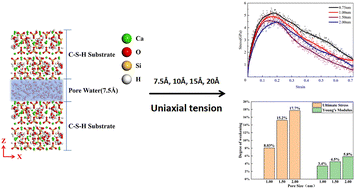
Water in calcium–silicate–hydrate (C–S–H) pores significantly affects its structural stability and mechanical properties. This study employs molecular dynamics (MD) methods to investigate the effects of pore water content on C–S–H under uniaxial tension. For various pore sizes (0.75 nm, 1.00 nm, 1.50 nm, and 2.00 nm), the impacts of pore water on the structure, chemical bonds, dynamics, and mechanical properties of C–S–H are examined. The results indicate a pronounced nanoconfinement effect in smaller pore size models, enhancing the symmetry and order of the atomic structure. However, increased water content disrupts this structural integrity to a certain extent. Regarding chemical bonding, tensile stress enhances the spatial correlation of specific atomic pairs (Ca0–Obos, Si–Ob, H*–O*). Meanwhile, increased pore water content introduces additional H and O atoms into the C–S–H structure, enhancing the formation of Ca0–Obos and Si–Ob bonds while disrupting the overall hydrogen bonding network. Consequently, the elevated water content damages the structural framework and increases the interlayer distance, ultimately degrading the overall mechanical performance. As the pore size increases from 0.75 nm to 2.00 nm, the tensile strength and Young's modulus decrease by 17.7% and 5.8%, respectively.
 Please wait while we load your content...


