


 PLATFORM UPDATE:

The primary near-UV photochemistry of aqueous pyruvic acid

Abstract
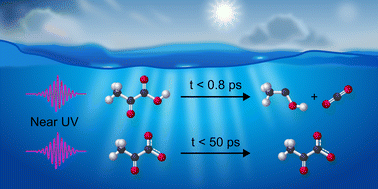
Near-UV photolysis of pyruvic acid results in decarboxylation within 0.8 ps. In contrast, pyruvate anions excited by near-UV light relax back to the ground state within 50 ps with no detectable photolysis. The sharply different behavior of the acid and its conjugate base provides a mechanistic explanation for the puzzling pH dependence of the pyruvic acid photolysis.
- This article is part of the themed collection: 2026 PCCP HOT Articles
 Please wait while we load your content...


