


 PLATFORM UPDATE:


Rotational dynamics of diammonium cations in lead bromide composites investigated by quasi-elastic neutron scattering

Abstract
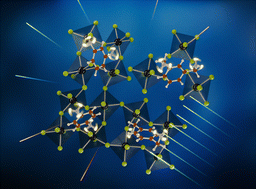
We report results from quasielastic neutron scattering (QENS) measurements of the dynamical nature of diammonium cations in the two-dimensional (2D) metal halide perovskites (MHPs) (1,3-PDA)PbBr4 (PDA: phenylenediammonium), (1,4-PDA)PbBr4, and (1,4-XDA)PbBr4 (XDA: xylylenediammonium), and in the zero-dimensional (0D) perovskitoid (1,3-XDA)2PbBr6. QENS spectra measured upon heating from 44 to 350 K reveal the onset of picosecond timescale dynamics of the respective organic cation at around 225 K for 1,3-PDA, 250 K for 1,4-PDA, 250 K for 1,3-XDA, and 350 K for 1,4-XDA. Analyses of the elastic incoherent structure factor of the materials suggest that the observed dynamics can be assigned to three-fold (C3) and/or continuous rotational jump-diffusion dynamics of the terminal –NH3 groups of the respective organic cation for all materials. An average, apparent, residence time of the jump-diffusion dynamics has been extracted from the QENS data and takes values of about 1 ps for (1,3-PDA)PbBr4, 4–5 ps for (1,4-PDA)PbBr4 and (1,3-XDA)Pb2Br6, and 10 ps for (1,4-XDA)PbBr4 at 350 K. A comparison of the dynamical results with the length and symmetry of the organic cations suggests that a smaller organic cation (here PDA) and an asymmetric position of the two –NH3 groups (here 1,3-PDA and 1,3-XDA) correlate with a lower onset temperature and faster dynamics. A comparison of the dynamics results with the photoluminescence (PL) spectra of the materials may indicate that slower –NH3 dynamics correlates with a lower thermal stability of PL due to less dynamic disorder.
 Please wait while we load your content...


