


 PLATFORM UPDATE:


Engineering the photonic spin Hall effect via strongly coupled epsilon-near-zero phonon polaritons
 *ab
*ab
Abstract
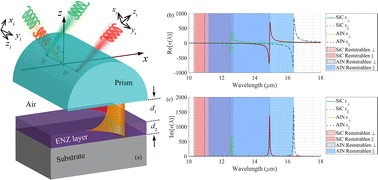
We propose and analyze an Otto-type prism coupling configuration that amplifies the photonic spin Hall effect (PSHE) by strongly coupling an epsilon-near-zero (ENZ) mode to the surface phonon polaritons. Using a 4 × 4 Berreman transfer-matrix formalism combined with an angular-spectrum description of Gaussian beams, we investigate attenuated total reflection spectra, reflection phases and spin-resolved lateral shifts, and derive analytical expressions that connect the PSHE to the angular derivatives of the Fresnel coefficients. We show that strong coupling between the AlN ENZ phonon polariton and the SiC surface phonon polariton produces a clear Rabi doublet with a splitting approaching 44 cm−1 and two hybrid polaritonic branches with ultra-steep p-polarized phase rolls. These hybrid modes yield giant, sign-tunable PSHE shifts exceeding 102 µm. We further demonstrate that the air-gap thickness and ENZ film thickness act as practical knobs to tune the coupling strength, spectral position, and polarity of the spin shift, enabling deterministic switching and broadband mid-infrared operation. Overall, this lithography-free, prism/air/ENZ/SiC platform provides a compact and experimentally accessible route to strongly coupled ENZ phonon polaritons for robust PSHE amplification, opening new opportunities for reconfigurable spin–photonic beam displacers, ultra-sensitive refractometric sensing, and phase-gradient metrology.
 Please wait while we load your content...


