


 PLATFORM UPDATE:


Sum-frequency vibrational spectroscopy of water at interfaces

Abstract
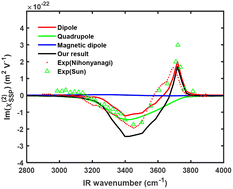
Combining neural network-based molecular dynamics simulations and quantum chemistry computations, we study sum-frequency vibrational spectroscopy (SFVS) of interfacial water. Using a genetic algorithm, we establish the relationships between the OH stretching frequency, the derivatives of the electric quadrupole and magnetic dipole polarizabilities, and the three components of the electric field (computed at grid points around the target water molecule) generated by surrounding water molecules. In this approach, we abandon the approximate formulas previously employed in studies to calculate the derivatives of the electric quadrupole polarizabilities. These newly derived relationships, along with those obtained from the mixed quantum/classical method, allow for the computation of interfacial water SFVS, showing agreement with experimental results. We propose two strategies to distinguish between electric dipole and quadrupole contributions in the SFVS of water.
 Please wait while we load your content...


