


Effect of site-specific lysine acetylation on tau binding to microtubules: mechanistic insights from all-atom molecular dynamics simulations
 c
and
Yu
Zou
*a
c
and
Yu
Zou
*a
Abstract
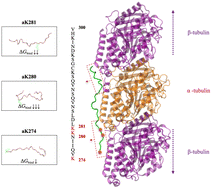
Tau protein plays a critical role in stabilizing microtubules (MTs) within neuronal axons, while its function can be altered by aberrant post-translational modifications, contributing to tauopathies such as Alzheimer's disease and chronic traumatic encephalopathy. Experimental studies have found that acetylation at K274, K280, and K281 disrupts tau–MT binding. However, the underlying molecular mechanism remains elusive. Herein, we performed all-atom molecular dynamics simulations to systematically investigate how acetylation at these three sites within the second MT-binding repeat (R2) of tau affects the conformation of the Tau_R2–MT complex. We found that acetylation at K274, K280, and K281 weakens the overall stability of the Tau_R2–MT complex. MM/PBSA calculations corroborate a decrease in binding affinity between Tau_R2 and MT, with the K280-acetylated system showing the largest loss and electrostatics accounting for most of the change. Contact analysis revealed site-specific patterns, with K274 and K281 acetylation primarily affecting the interfacial contacts at the C-terminal region of Tau_R2, while K280 acetylation affected both the N- and C-terminal regions. Moreover, acetylation induced a more compact Tau_R2 conformation and enhanced intramolecular contacts, further compromising the stability of MT. This study provides site-specific mechanistic insights into how lysine acetylation weakens the Tau_R2–MT binding and can guide the development of new therapeutics against tauopathies from the perspective of post-translational modifications.
 Please wait while we load your content...


