


 PLATFORM UPDATE:


Heating-rate and size-dependent melting, structural disorder, and diffusion in Au–Cu alloys: a molecular dynamics study

Abstract
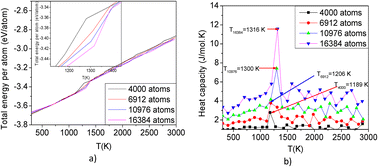
In this work, we present a systematic investigation of the structural evolution, phase transitions, and atomic mobility in equiatomic Au–Cu alloys using molecular dynamics simulations with embedded atom method (EAM) potentials. Systems containing 4000–16 384 atoms were subjected to continuous heating under periodic boundary conditions to examine the effects of system size and heating rate on melting behavior. Structural descriptors including radial distribution functions, static structure factors, bond orientational order parameters (Q4, Q6, W6), configurational entropy, and the Lindemann index were combined with mean square displacement and self diffusion analyses to identify and quantify the solid–liquid transition. We find that increasing system size sharpens thermodynamic signatures of melting and shifts the apparent transition toward the bulk limit, while ultrafast heating induces pronounced superheating. Arrhenius representations of self diffusion coefficients reveal distinct diffusion regimes below and above the melting interval, with Cu exhibiting consistently higher mobility than Au. A unified picture of disordering emerges from concurrent changes in structural, entropic, and diffusional indicators, providing quantitative insights into thermal stability and atomic transport in Au–Cu alloys. These findings offer guidance for the thermal design of noble metal materials where melting and diffusion phenomena are critical.
 Please wait while we load your content...


