


 PLATFORM UPDATE:


Monolayer Sc2NF2 and Sc2NO2 electrodes for bilayer MoS2: achieving symmetric and excellent performances

Abstract
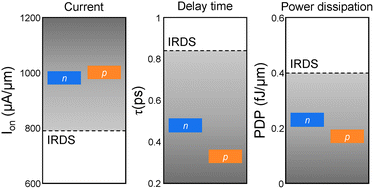
Achieving n- and p-type symmetric and excellent two-dimensional Schottky barrier field-effect transistors (SBFETs) remains a significant challenge, particularly when employing a homogeneous channel. The electrode contact properties for bilayer (BL) MoS2 and the corresponding device performances are investigated using ab initio calculations. Stable van der Waals-type heterojunctions are formed between BL MoS2 and monolayer (ML) Sc2NX2 (X = F or O) in primitive cells, resulting in Ohmic contacts at both vertical and lateral interfaces. Consequently, excellent and symmetric n- and p-type device performances are obtained in 10-nm-gate BL MoS2 SBFETs with ML Sc2NF2 and Sc2NO2 electrodes operating at 0.5 V for high-performance applications. These results surpass the International Roadmap for Devices and Systems targets specified as the ‘5am eq’ note for 12 nm gate devices operating at 0.6 V. The outstanding and symmetric performance indicates that BL MoS2 SBFETs with ML Sc2NF2 and Sc2NO2 electrodes are promising post-Si candidates for high-performance logic circuits.
 Please wait while we load your content...


