


 PLATFORM UPDATE:

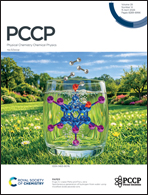
The thermal decomposition mechanism of energetic cyclopentazolate salt N2H5N5: a deep neural network potential accelerated molecular dynamics study
 *ab
*ab
Abstract
As a nitrogen-rich metal-free energetic salt, crystalline N2H5N5 with a cyclopentazolate anion has been recently synthesized, but its decomposition mechanism is far from clear. In this study, a neural network potential (NNP) has been developed to investigate the complex reaction dynamics of N2H5N5. Large-scale ab initio-quality molecular-dynamics simulations driven by this model demonstrate that the NNP accurately captures the time-resolved emergence and disappearance of intermediate species in the reaction of the bulk crystal. The triggering event is synchronous: the N2H5+ cation initiates a step-wise dehydrogenation while the N5− ring undergoes either (i) direct cleavage or (ii) hydrogen-assisted opening. Once these two “ignition” steps have occurred, the subsequent chemistry is that successive H-stripping from N2H5+ and rapid rearrangement of the opened N5− chain lead almost exclusively to the formation of N2 and NH3 with only trace amounts of radicals. This simplicity stands in sharp contrast to CHON explosives such as TNT or RDX, where initiation is dominated by nitro-group scission and the ensuing NO2-driven redox cascade spawns a tangled network of hundreds of intermediates. Furthermore, we have calculated the apparent activation energy of the decomposition of N2H5+ and N5−, revealing that N2H5+ is consumed significantly faster than N5−. This work not only clarifies the decomposition mechanism of N2H5N5 but also provides a reliable approach for studying energetic ionic salts, contributing to a deeper understanding of their chemistry.

 Please wait while we load your content...


