


 PLATFORM UPDATE:


Dissecting olfactory receptor binding pocket gating induced by structurally similar odorants furaneol and sotolone through molecular dynamics simulations
 g
Xiaohui
Wang
*ah
g
Xiaohui
Wang
*ah
Abstract
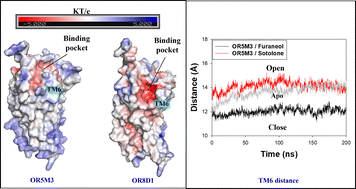
Human odor perception depends on a repertoire of roughly 400 odorant receptors (ORs), a subfamily of G protein-coupled receptors (GPCRs) that detect volatile molecules through combinatorial activation. Intriguingly, even structurally similar odorants can evoke distinct perceptual qualities by selectively activating different ORs—a specificity that remains poorly understood and often eludes conventional docking-based predictions. Here, we explore the molecular basis of this selectivity using two structurally similar flavorants, furaneol and sotolone, which specifically activate OR5M3 and OR8D1, respectively. While docking and free energy analyses provided initial insights, they could not fully explain the observed selectivity. Therefore, extensive MD and metadynamics simulations were performed, revealing that odorant ligands modulate TM6 dynamics in ORs, whose motion may serve as a key gating event coupling extracellular closure for ligand binding with intracellular opening for G-protein engagement. In contrast, non-associated ligands could result in an outward displacement of the extracellular region of TM6, thereby promoting receptor inactivation through pocket opening and ligand release. Moreover, the simulations reveal that the negatively charged deprotonated state of both furaneol and sotolone drives the opening of the binding pockets in both OR5M3 and OR8D1, suggesting that these ORs are sensitive to ligand charge and protonation state. Together, these findings establish a molecular framework for predicting olfactory receptor ligand-binding modes in the early activation state and offer new insights into rational design in flavor chemistry and sensory neuroscience.
 Please wait while we load your content...


