


 PLATFORM UPDATE:


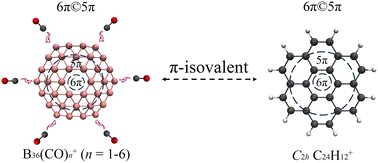
Observation of quasi-planar boron carbonyl complexes B36(CO)n+ (n = 1–6) analogous to coronene monocation C24H12+
 *a
Si-Dian
Li
*a
*a
Si-Dian
Li
*a
Abstract
The discovery of quasi-planar C6v B36 and C2v B36− (Piazza et al., Nat. Commun., 2014, 5, 3113) provided the first experimental evidence for the viability of 2D borophene nanomaterials. Joint chemisorption experiment and first-principles theory investigations conducted herein indicate that, as the well-defined global minimum of the monocation, geometrically similar to C6v B36 and C2v B36−, the size-selected quasi-planar C2v B36+ (1) with six approximately equivalent tri-coordinate vertex B atoms can consecutively chemisorb up to six CO molecules under ambient conditions to form a series of quasi-planar B36(CO)n+ analogous to coronene monocation C2h C24H12+ in π-bonding, presenting the largest boron carbonyl aromatics (BCAs) observed to date. Kinetic studies have demonstrated that quasi-planar C2v B36+ is about 10, 100, and 1000 times less reactive in experiments towards the first CO than the previously reported perfect planar C2v B13+, double-ring tubular D2d B20+, and quasi-planar Cs B11+ and C2v B15+, respectively. Extensive theoretical calculations and analyses revealed the chemisorption pathways and bonding patterns of the experimentally observed B36(CO)n+ and their neutral counterparts B36(CO)n (n = 1–6), which appear to possess two concentric delocalized π systems over the molecular plane analogous to that of coronene monocation C2h C24H12+ (6π©5π) and neutral coronene D6h C24H12 (6π©6π), respectively, imparting dual π-aromaticity and high stability to the systems.
 Please wait while we load your content...


