


 PLATFORM UPDATE:


Tuning gas transport and separation in ZIF-8 membranes via point defects: insights from non-equilibrium molecular dynamics
 *ab
and
*ab
and
Abstract
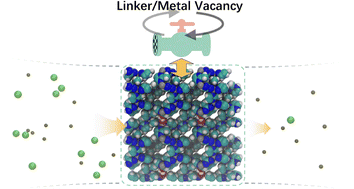
Understanding how intrinsic defects influence gas transport in metal–organic framework (MOF) membranes is crucial for the rational design of high-performance separation materials. In this study, non-equilibrium molecular dynamics (NEMD) simulations were employed to systematically investigate the permeation of four gases (He, N2, CH4, and CO2) and relevant mixtures (He/CH4, CH4/N2, and CO2/N2) through pristine and defective ZIF-8 membranes. Two representative point defects, linker vacancies and Zn vacancies, were studied to assess their impact on membrane performance. The pristine membrane exhibited permeabilities and selectivities in agreement with experimental data, validating the reliability of the simulation methodology. For defective membranes, linker vacancies were found to enlarge pore apertures and reduce migration barriers significantly, leading to up to an order-of-magnitude enhancement in permeability. In contrast, Zn vacancies introduced local structural flexibility and energetic heterogeneity, increasing diffusion resistance for larger gases while leaving He transport almost unaffected. Mixed-gas simulations revealed that these defects have distinct, gas-specific effects on the separation performance: linker vacancies significantly improve CH4/N2 selectivity and the overall performance but limit He/CH4 and CO2/N2 separations, whereas Zn vacancies show potential to enhance He/CH4 separation by selectively suppressing CH4 permeability. These findings highlight that defect engineering can induce strong, gas-specific shifts in MOF-membrane performance, which might provide a useful foundation for designing and fully exploiting tailored MOF membranes.
 Please wait while we load your content...


