


 PLATFORM UPDATE:


The accuracy of carbon-13 NMR magnetic-shielding tensors calculated using periodic DFT: a case study on the distinction of crystalline serine phases
 ab
Ettore
Bartalucci,
ab
Mirijam
Zobel,
c
Carsten
Bolm,
d
Maria
Fyta
*ef
and
Thomas
Wiegand
*ab
ab
Ettore
Bartalucci,
ab
Mirijam
Zobel,
c
Carsten
Bolm,
d
Maria
Fyta
*ef
and
Thomas
Wiegand
*ab
Abstract
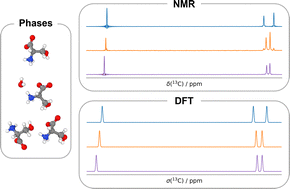
Carbon-13 nuclear magnetic resonance (NMR) spectroscopic fingerprints enable the unambiguous identification of a chemical compound. Ab initio calculations of NMR magnetic-shielding tensors are crucial for facilitating spectral resonance assignment, but require an accuracy on the order of one ppm or even less for carbon-13 for distinguishing structurally rather similar compounds, such as structural isomers and polymorphs. Using quantum-mechanical calculations within the density functional theory (DFT) approach and solid-state NMR spectroscopy under magic-angle spinning (MAS) conditions, we herein explore whether the accuracy of current DFT levels is sufficient to distinguish between three distinct solid phases of the amino acid serine using computer simulations. In that vein, enantiopure L-serine, L-serine monohydrate, and racemic DL-serine have been studied. Using solid-state calculations employing periodic boundary conditions, we computed NMR observables, such as 13C isotropic magnetic-shielding values and 13C magnetic-shielding anisotropy parameters of these phases. Different levels of DFT theory utilizing distinct exchange correlation functionals were tested in optimizing the hydrogen-atom positions prior to NMR observable calculations, which significantly improved the agreement with the experimental values. The comparison of the measured and the calculated observables confirmed the distinction between the serine phases not only experimentally but also by DFT calculations. We also compare the DFT-calculated NMR observables with predictions from a recently proposed machine learning (ML) approach. Our analysis clearly revealed that a rather low-cost exchange correlation functional in periodic solid-state DFT calculations reaches the desired accuracy of 13C magnetic-shielding tensor calculations, provided that highly accurate initial structures are applied. These results underline that complementary experimental and computational studies can provide key insights into molecular systems and the interactions therein, enabling the distinction of structurally similar compounds (often polymorphs), which is of particular importance in pharmaceutics.
 Please wait while we load your content...


